If you are a mobile content creator who relies on Rode’s high-end wireless audio systems, your workflow just got significantly lighter. In a move that bridges the gap between professional filmmaking and quick social media content, Rode has released a major firmware update that fundamentally changes how the Wireless PRO and Wireless GO (Gen 3) operate.
For years, the standard drill for recording high-quality audio on a phone involved a bit of a juggling act: plugging a receiver into the lightning or USB-C port, making sure the dongle didn’t wiggle loose, and balancing the added weight on your gimbal or rig. That friction is officially a thing of the past.
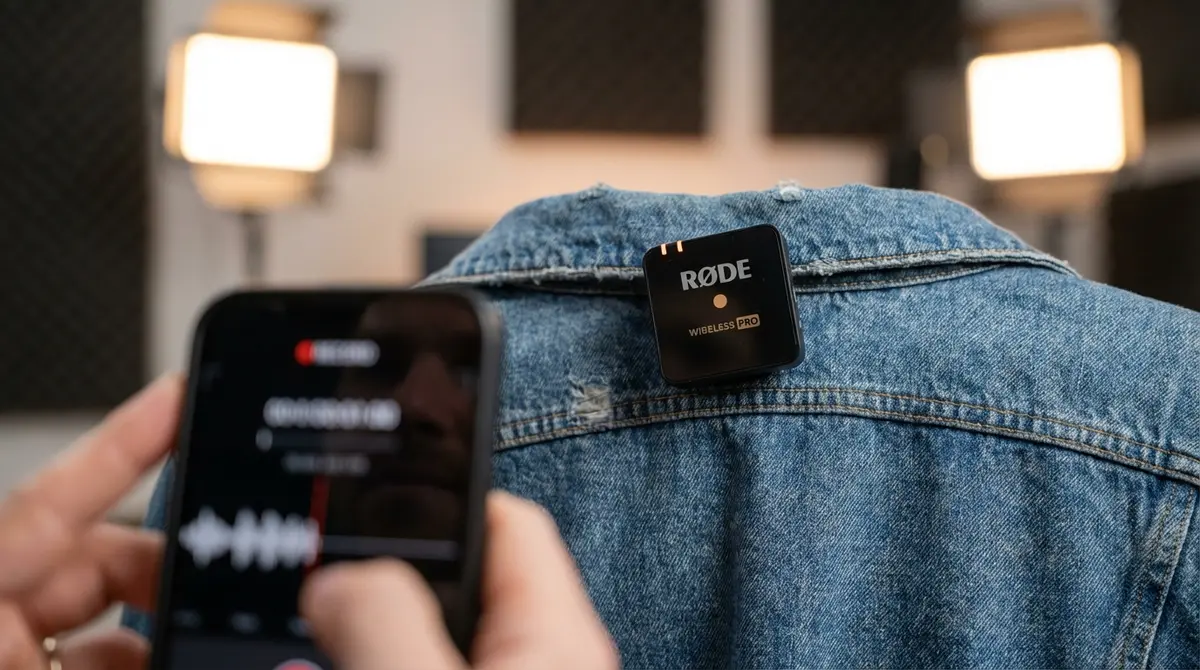
Rode is rolling out its "Direct Connect" feature to its flagship microphones. This update allows the transmitters to bypass the receiver entirely and pair directly with your iPhone or iPad via Bluetooth. It is a massive quality-of-life improvement that transforms these professional tools into run-and-gun powerhouses.
How does Direct Connect actually work?
The concept behind Direct Connect is refreshing in its simplicity. Instead of the traditional transmitter-to-receiver-to-phone signal path, the microphone transmitter now acts as a direct Bluetooth input device for your iOS hardware. This technology was first debuted in the consumer-focused Wireless Micro, but seeing it ported over to the "Pro" line is a pleasant surprise.
To make this magic happen, you will need to use the Rode Capture iOS app. Once your firmware is updated, the app recognizes the transmitter as a direct audio source. This eliminates the need for physical cabling or the receiver unit when you are shooting mobile content. According to Rode CEO Damien Wilson, the company views this as a duty to "extend true wireless freedom to as many creators as possible," building on the success they have already seen with the Wireless Micro integration.
Does this compromise audio quality?
This is the first question any audio engineer asks when they hear the word "Bluetooth." Bluetooth audio has historically been plagued by compression and latency issues that make it unsuitable for professional broadcast work. However, Rode claims they have cracked the code.
The company states that Direct Connect operates without compromising "the broadcast-quality audio both wireless systems are known for." While the specific bitrate details of the Bluetooth transmission compared to the proprietary 2.4GHz transmission weren’t detailed in the release notes, the functionality remains robust. You still retain the ability to record from two transmitters simultaneously.
The system supports both recording modes that pros rely on:
Merged Mode: Blends audio from both transmitters into a single stereo track (great for quick turnaround).
Split Mode: Keeps recordings on separate channels, giving you the flexibility to mix levels independently in post-production.
Which microphones are getting this upgrade?
It is important to note that this update applies to specific hardware. The firmware update is available for the Wireless PRO and the recently released Wireless GO (Gen 3).
The Wireless GO (Gen 3), which launched in December 2024, already brought 32-bit float recording to the standard "GO" line, and this update further distinguishes it from the older Wireless GO II. If you are still rocking the Gen 2, you are unfortunately out of luck for this specific feature.
The update is free and available immediately. You can access it by connecting your transmitters to the Rode Central desktop app, which will prompt you to install the new firmware.
Why is this a big deal for creators?
This update represents a significant shift in the market. Until now, if you wanted direct Bluetooth connectivity to a phone, the DJI Mic 2 was the primary contender offering that streamlined experience. Rode’s Wireless PRO was often seen as the superior tool for camera-based shooters due to its timecode and 32-bit float capabilities, but it lacked that mobile convenience.
By adding this feature via software, Rode has effectively neutralized one of its main competitor’s unique selling points. It acknowledges the reality of the modern "hybrid" creator—someone who might shoot a commercial on a cinema camera in the morning but needs to capture high-fidelity behind-the-scenes content on an iPhone for TikTok in the afternoon. Now, the same transmitter works seamlessly for both workflows without needing to re-rig a receiver.
What This Really Means
This is a strategic counter-strike against DJI in the battle for the "prosumer" wallet. By unlocking Bluetooth capabilities on existing high-end hardware, Rode is dramatically increasing the value proposition of the Wireless PRO and GO Gen 3 without forcing users to buy new gear. It signals that Rode understands the friction points of modern content creation—specifically, that the "best" microphone is often the one that is easiest to set up. For the industry, this cements the trend that professional audio gear must now be mobile-native, not just mobile-compatible. The receiver is no longer the gatekeeper to professional audio; it is now optional.
![Illustration related to Rode Wireless PRO Direct Connect Update: No Receiver [2026]](https://explore.bytewire.press/wp-content/uploads/bytewire-images/2026/02/rode-wireless-pro-1f8f7ec479.webp)
![Diagram related to Rode Wireless PRO Direct Connect Update: No Receiver [2026]](https://explore.bytewire.press/wp-content/uploads/bytewire-images/2026/02/rode-wireless-pro-917efb180a.webp)