In a move that signals a seismic shift in how venture capital views African defense technology, Terra Industries has secured an additional $22 million in a seed extension round led by Lux Capital. This brings the Abuja-based startup’s total seed funding to approximately $34 million—a staggering sum for a hardware-focused company that only emerged from stealth a month ago. Founded by Gen Z entrepreneurs Nathan Nwachuku and Maxwell Maduka, Terra is not merely building drones; they are attempting to construct a vertically integrated defense prime on a continent historically reliant on fragmented foreign imports.
The speed of this capital injection highlights a rare convergence of high-risk appetite and geopolitical necessity. Just weeks after announcing an initial $11.75 million seed round led by Joe Lonsdale’s 8VC, which saw participation from firms like Valor Equity Partners and SV Angel, Terra has secured additional backing in its extension round led by Lux Capital, with new investors including Resilience17 Capital and Belief Capital. The mission is clear: to digitally geofence Africa’s critical infrastructure against escalating threats.
Why Are Investors Betting Big on African Defense Tech?
The narrative surrounding African technology has long focused on fintech and logistics. However, Terra Industries represents a departure into “hard tech,” a sector often deemed too capital-intensive and risky for the region. The driving force behind this investment is the massive gap between Africa’s industrial ambition and its security reality. With nearly $100 billion invested annually in infrastructure across the continent, assets such as power plants, mines, and oil refineries remain vulnerable to terrorism and organized crime.
Investors are betting that Terra’s indigenous approach can succeed where foreign contractors have faltered. Historically, African nations have relied on defense solutions from China, Russia, and the West. These solutions often lack local integration, suffer from supply chain lags, and come with heavy geopolitical strings attached. Terra’s model mirrors the rise of companies like Anduril in the United States—agile, software-defined, and vertically integrated.
What Is ArtemisOS and How Does It Secure $11 Billion in Assets?
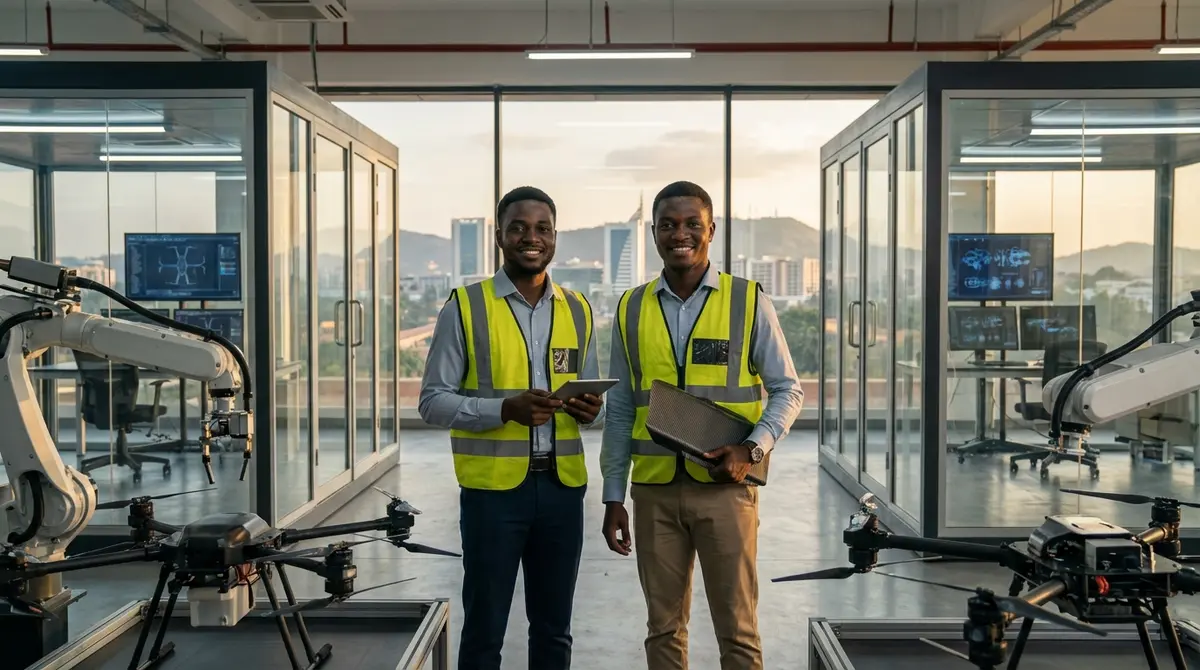
At the core of Terra’s offering is ArtemisOS, a proprietary software platform that serves as the nervous system for its hardware. The company manufactures autonomous systems, including drones and sentry towers, at a 15,000-square-foot facility in Abuja, Nigeria. Unlike traditional defense hardware that operates in silos, Terra’s devices are designed to work in concert, creating a cohesive “digital geofence” around valuable targets.
According to company data, this technology is already operational. Terra reports that its systems are currently protecting critical infrastructure in Nigeria and Ghana, securing assets valued at over $11 billion. This traction is significant; it moves the company from the realm of theoretical R&D to a proven utility in high-stakes environments. By controlling both the hardware manufacturing and the software layer, Terra can iterate rapidly based on real-world feedback from the field—a luxury foreign competitors rarely enjoy.
Who Are the Gen Z Founders Challenging Global Incumbents?
The leadership profile of Terra Industries is as disruptive as its technology. CEO Nathan Nwachuku (22) and CTO Maxwell Maduka (24) are challenging a defense industry dominated by legacy players and seasoned veterans. Despite their age, they have garnered the support of deep-tech heavyweights. Alex Moore, a partner at 8VC, noted that the duo has “assembled a brilliant team to tackle a vital problem for the continent.”
Their ambition extends beyond Nigeria. While competitors like South Africa’s Milkor, Paramount Group, and Hensoldt occupy the market, Terra is positioning itself as a pan-African, and potentially inter-regional, player. The company recently announced a partnership with AIC Steel to establish a manufacturing hub in Saudi Arabia, signaling intent to expand into the Middle East. “This is African technology, built by African engineers, for African infrastructure,” Maduka stated, emphasizing the sovereign nature of their solution.
What This Really Means
The rapid ascent of Terra Industries validates a new thesis: sovereignty is the killer app for emerging markets. For decades, African defense spending has been a mechanism for wealth transfer to foreign contractors, leaving nations with disjointed systems they cannot maintain. Terra is flipping this model by proving that high-grade defense technology can be built locally, retaining both the capital and the strategic data within the continent. This is bad news for mid-tier defense exporters in China and Eastern Europe who rely on these markets for offloading legacy hardware. If Terra can execute on its manufacturing roadmap, it won’t just be a defense company; it will be the blueprint for how industrial sovereignty is achieved in the Global South.
![Illustration related to Terra Industries Raises $22M Seed Extension [Analysis]](https://explore.bytewire.press/wp-content/uploads/bytewire-images/2026/02/terra-industries-raises-22m-seed-extension-lux-capital-bd958087e6.webp)
![Diagram related to Terra Industries Raises $22M Seed Extension [Analysis]](https://explore.bytewire.press/wp-content/uploads/bytewire-images/2026/02/terra-industries-raises-22m-seed-extension-lux-capital-ba5c63adfe.webp)